dynamic polymers pattern cells
Cells reorganize their shape and contents in space and time to move and divide. These complex behaviors are driven by networks of intracellular polymers called the cytoskeleton. Using the same nanometer-scale building blocks, cells build different micron-scale structures like microtubule-based spindles that generate force to segregate DNA, centrosomes that organize polarized arrays to pattern the cell, and cilia that beat to generate force for fluid flow and motility. As cells transition between states, these structures are remodeled to meet new needs. Defects in these cytoskeletal structures cause human diseases including ciliopathies (e.g. polycystic kidney disease, primary ciliary dyskinesia, infertility) and cancers. We use cell biological and biophysical approaches combined with high-resolution microscopy to investigate the remodeling of microtubule-based structures critical for proper cell function.
How do cells selectively remodel part of a cytoskeletal structure? How is the remodeling of the cytoskeleton coordinated synchronously across large cells and how is it coupled to cell polarity? What are the core principles that underly robust cellular organization – how and when did these emerge in evolution and what causes them to fail in disease?
chytrid fungi as a model for evolutionary cell biology
We study chytrid fungi as a powerful comparative system to probe core underlying principles of eukaryotic cellular organization. These unicellular organisms have a complex and highly conserved microtubule cytoskeleton, including centrioles and cilia that were lost in other fungal lineages. Chytrids dramatically remodel their cytoskeleton over a short, synchronous lifecycle. The extreme changes in cell size and shape in the chytrid lifecycle exaggerate fundamental organizing and remodeling challenges of the microtubule cytoskeleton. Importantly, chytrids also parasitize organisms from amphibians to algae, so deeper understanding of chytrid cell biology will also uncover new insights about host-parasite interactions with broad ecological implications.
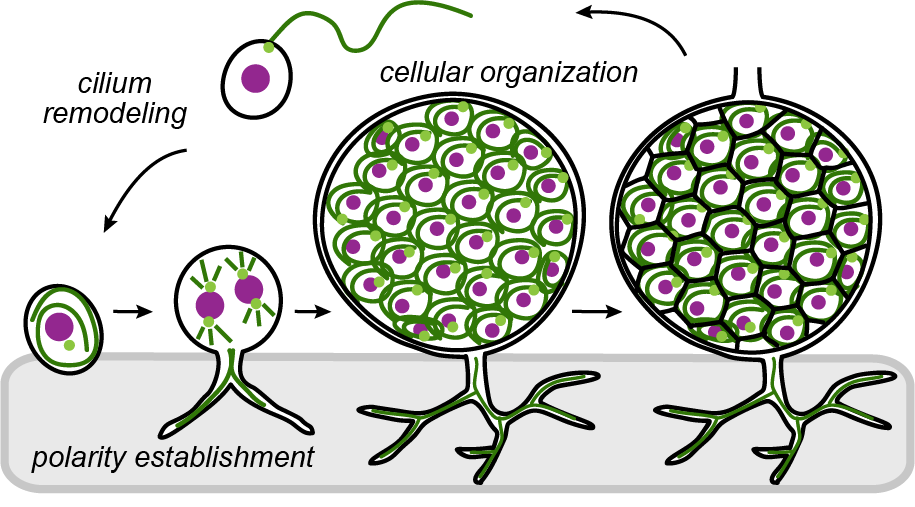

Top: Chytrid lifecycle from small motile zoospore to large multinucleated sporangium. Bottom: Expansion microscopy reveals the chytrid cytoskeleton at high-resolution.
 Long Research Group